
API Design Patterns for Scalable Applications (REST vs GraphQL vs tRPC)
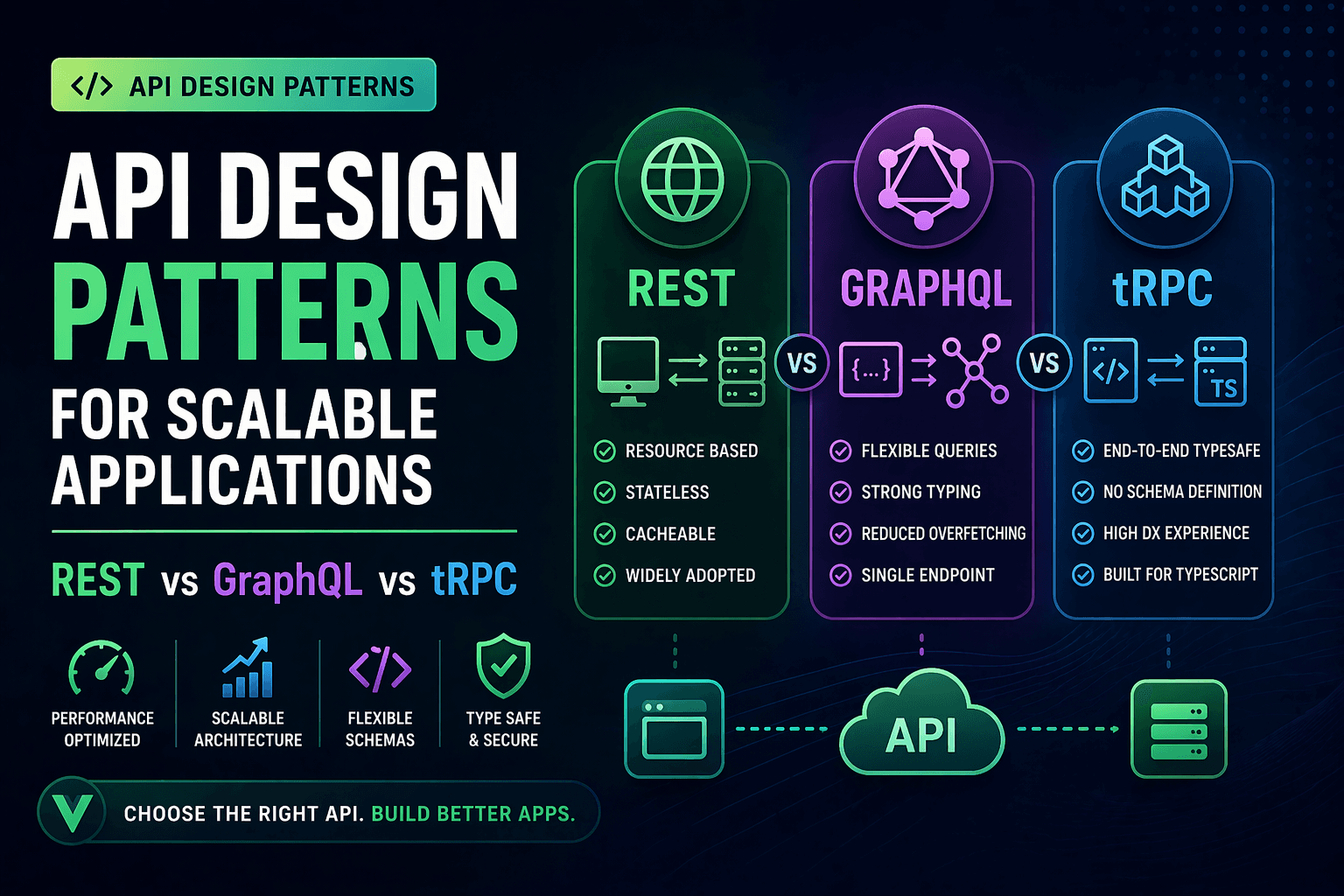
Modern web applications depend heavily on APIs to connect frontend and backend systems. As applications scale, choosing the right API architecture becomes a critical decision that directly impacts performance, maintainability, and developer experience.
In this article, we will explore three major API design patterns used in modern applications: REST, GraphQL, and tRPC. We will compare them, understand their trade-offs, and see when each one makes sense.
Why API Design Matters in Scalable Applications
API design is not just about fetching or sending data. It defines how different parts of your system communicate. Poor API design leads to:
- Over-fetching or under-fetching of data
- Tight coupling between frontend and backend
- Poor performance at scale
- Complex maintenance and versioning issues
A well-designed API ensures that your system remains fast, flexible, and scalable as it grows.
REST API: The Traditional Standard
REST (Representational State Transfer) is the most widely used API architecture. It is based on standard HTTP methods and resource-based URLs.
Key Characteristics of REST
- Uses HTTP methods (GET, POST, PUT, DELETE)
- Resource-based endpoints
- Stateless communication
- Typically returns JSON data
Example REST API
GET /api/users
GET /api/users/1
POST /api/users
PUT /api/users/1
DELETE /api/users/1
Advantages of REST
- Simple and widely adopted
- Easy to cache using HTTP caching
- Works well with most clients and tools
- Great for public APIs
Disadvantages of REST
- Over-fetching or under-fetching data
- Multiple requests needed for related data
- Versioning complexity as APIs evolve
GraphQL: Flexible Data Querying
GraphQL is a query language for APIs developed by Facebook. It allows clients to request exactly the data they need, nothing more and nothing less.
Key Characteristics of GraphQL
- Single endpoint for all requests
- Client defines the structure of the response
- Strongly typed schema
- Supports real-time data via subscriptions
Example GraphQL Query
query {
  user(id: 1) {
    name
    email
    posts {
      title
    }
  }
}
Advantages of GraphQL
- Eliminates over-fetching and under-fetching
- Single request for complex data structures
- Strong typing improves developer experience
- Great for frontend-driven applications
Disadvantages of GraphQL
- Complex backend setup
- Caching is more difficult compared to REST
- Performance issues if not optimized properly
- Learning curve for beginners
tRPC: End-to-End Type Safety
tRPC is a modern API approach that allows you to call backend functions directly from the frontend with full TypeScript safety. It removes the need for schema definitions or manual API contracts.
Key Characteristics of tRPC
- No REST or GraphQL schema required
- End-to-end type safety with TypeScript
- Direct function calls between frontend and backend
- Ideal for full-stack TypeScript applications
Example tRPC Procedure
// Backend
const appRouter = router({
  getUser: publicProcedure
    .input(z.object({ id: z.number() }))
    .query(({ input }) => {
      return db.user.findById(input.id)
    })
})

// Frontend
const user = trpc.getUser.query({ id: 1 })
Advantages of tRPC
- Full type safety across frontend and backend
- No need for API documentation or schema sync
- Faster development experience
- Less boilerplate code
Disadvantages of tRPC
- Tightly coupled frontend and backend
- Only works well with TypeScript
- Not ideal for public APIs
- Smaller ecosystem compared to REST and GraphQL
REST vs GraphQL vs tRPC: Key Differences
Each API design pattern solves different problems. Here’s a high-level comparison:
REST:
- Multiple endpoints
- Fixed response structure
- Easy caching

GraphQL:
- Single endpoint
- Flexible queries
- Client-driven data

tRPC:
- Function-based calls
- End-to-end types
- Best for full-stack TS apps
When to Use REST
REST is a great choice when:
- You are building public APIs
- You need simple CRUD operations
- SEO or caching is important
- You want maximum compatibility
When to Use GraphQL
GraphQL is ideal when:
- You have complex frontend data requirements
- Multiple clients consume the same API
- You want to reduce API calls
- You are building dashboard-heavy applications
When to Use tRPC
tRPC is best when:
- You are building a full-stack TypeScript app
- You want maximum developer productivity
- You control both frontend and backend
- You are building SaaS products or internal tools
Performance Considerations
REST Performance
REST performs well with caching strategies like CDN and HTTP caching headers. However, multiple round trips can slow down complex data fetching.
GraphQL Performance
GraphQL reduces network requests but can suffer from inefficient queries if not optimized properly (N+1 problem).
tRPC Performance
tRPC is highly efficient for internal systems since it avoids schema parsing and uses direct function calls.
Security Considerations
- REST: Relies on standard authentication (JWT, OAuth)
- GraphQL: Requires query depth limiting and rate limiting
- tRPC: Security depends on backend validation (no automatic exposure)
Common Mistakes in API Design
- Over-fetching large datasets in REST APIs
- Not optimizing GraphQL resolvers
- Overusing tRPC in public-facing APIs
- Ignoring caching strategies
Real-World Architecture Choice
In real SaaS applications, companies often combine multiple API patterns:
- REST for public APIs and integrations
- GraphQL for complex frontend dashboards
- tRPC for internal admin panels
This hybrid approach provides flexibility while maintaining scalability.
Conclusion
Choosing the right API design pattern is not about following trends—it is about understanding your application’s needs.
REST offers simplicity and universality, GraphQL provides flexibility and efficiency, and tRPC delivers unmatched developer experience in full-stack TypeScript applications.
For scalable systems, the best approach is often a combination of these tools based on context rather than a one-size-fits-all solution.